Many companies have implemented HR software – yet HR teams remain chronically overloaded.
Reports look professional, data is neatly stored, dashboards are available at the click of a button. And still, HR professionals spend a large share of their time on repetitive administrative work instead of strategic people topics.
The core issue: A lot of HR tools were designed for documentation and traceability, not for genuine workload reduction.
This article addresses exactly the questions HR leaders, executives, and HR practitioners type into Google and AI tools – and structures them into a clear decision framework.
Why is our HR software not reducing the HR workload?
Many organizations discover after going live with new HR software: The files are digital, but the stress has not changed. Studies indicate that HR teams still spend up to 40% of their time on repetitive administrative tasks, even with tools in place.
There are three recurring reasons:
- The software merely digitizes the status quo.
Existing, often historically grown processes are copied into the tool 1:1 instead of being redesigned. Paper is replaced by forms, but the underlying flow remains equally complex.
- The software was built as a record system, not as a workflow engine.
Many tools have been optimized for record-keeping, compliance, and reporting obligations – not for removing work steps altogether.
- The end-to-end workflow is ignored.
Leave request, approval, handover to payroll, communication back to the employee – if only parts of this chain are digital, the workload is merely shifted from paper to browser.
The result: HR documents more than ever – but is not relieved in proportion.
Before you roll out another solution, it is worth taking a closer look at how the tool operates. Typical signs that a system is focused on documentation rather than relief include:
- Many input fields, few automations.
If the tool mainly provides forms but offers few rules or automations (e.g. automatic reminders, approval chains, handover to other systems), it is essentially a digital archive.
- Manual exports for almost every analysis.
If HR frequently exports data to Excel or BI tools and manually cleans and merges it, documentation has been prioritized over insight.
- No or weak integrations.
Missing integrations are a major source of dissatisfaction among HR professionals. This is a clear indicator of siloed tools.
- More clicks than before.
If employees and managers feel they need “three portals for every vacation day,” frustration grows. Research calls this “fragmentation frustration”: too many tools, too little flow.
A simple test:
Ask your HR team for which recurring tasks the tool saves time – and for which tasks it simply ensures that everything is “properly recorded.” Where the second category dominates, you have a documentation tool, not a relief solution.
Visualizing the Problem: The HR Digitization Pyramid
To understand why genuine relief is often missing, it helps to look at the maturity levels of HR digitization. Many companies get stuck on the bottom tier (documentation), even though the actual reduction in workload only begins above it.
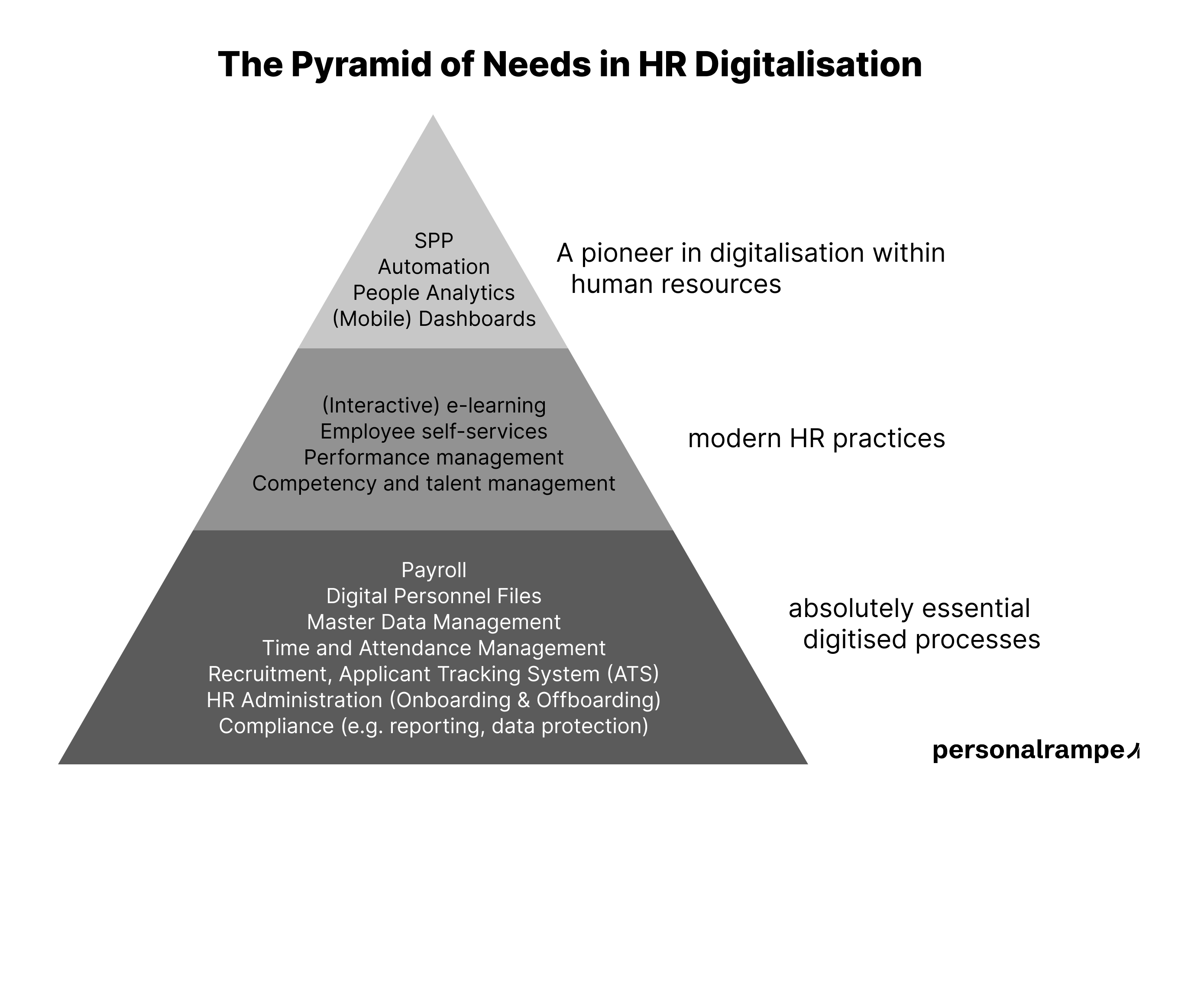
As the pyramid illustrates, processes like time tracking, payroll, or the digital personnel file are mandatory fundamentals. They represent the baseline. However, modern HR management—which enables employee retention and strategic leadership—requires the middle tier: competency and talent management, performance management, and self-services. If you only build the foundation, you are merely documenting.
Work overload is a reality in HR, not only due to talent shortages but also due to the tool landscape itself.
Three effects reinforce each other:
- Tool fragmentation
Many organizations use separate tools for recruiting, time tracking, learning, performance, talent management, and communication. Companies use six to eight different tools just for people-related tasks on average. Every login and every duplicate data entry adds friction.
- Data silos
When systems are not integrated, HR must manually synchronize data: creating and updating master data, merging information from different sources into coherent reports. One click in marketing quickly becomes five clicks in HR.
- Focus on reporting instead of steering
A lot of solutions are excellent at generating reports – but weak at supporting operational decisions (e.g. “Who has the skills for this project?”). HR delivers numbers, but rarely receives meaningful decision support in return.
The consequence: Digital tools are perceived as an additional layer – not as relief, but as “one more system that needs to be maintained.”
What kind of HR system do companies actually need now?
The HR tech market is crowded, but not every new tool addresses the relief problem. For mid-sized and growing organizations, systems are especially valuable that:
- think in processes rather than modules (from trigger event to follow-up action),
- provide robust integrations with existing core systems,
- make skills and capacity visible, not just master data.
Skill-centric solutions sit exactly at this intersection: They connect operational processes (onboarding, project staffing, development reviews) with a living skill profile for each employee – and thereby create the foundation for genuine relief.
If you want to assess whether your current tools primarily document or truly relieve HR, one question is particularly telling:
If we launched a new strategic project tomorrow, could we identify the right internal skills within minutes?
If the answer is “No,” your issue is not your HR team – it is your system landscape.
This is where Personalrampe Skills comes in: We make skills, experience, and potential visible – so HR tools don’t just document but genuinely support decisions and resource allocation.
Learn more: Personalrampe Skills


